AI For Students Essay

AI For Students Essay — independent reviews, comparisons, pricing and step-by-step guides on Aizhi.

  • Channel (digital image)

    Channel (digital image)

    Color digital images are made of pixels, and pixels are made of combinations of primary colors represented by a series of code. A channel in this context is the grayscale image of the same size as a color image, made of just one of these primary colors. For instance, an image from a standard digital camera will have a red, green and blue channel. A grayscale image has just one channel. In geographic information systems, channels are often referred to as raster bands. Another closely related concept is feature maps, which are used in convolutional neural networks. == Overview == In the digital realm, there can be any number of conventional primary colors making up an image; a channel in this case is extended to be the grayscale image based on any such conventional primary color. By extension, a channel is any grayscale image of the same dimension as and associated with the original image. Channel is a conventional term used to refer to a certain component of an image. In reality, any image format can use any algorithm internally to store images. For instance, GIF images actually refer to the color in each pixel by an index number, which refers to a table where three color components are stored. However, regardless of how a specific format stores the images, discrete color channels can always be determined, as long as a final color image can be rendered. The concept of channels is extended beyond the visible spectrum in multispectral and hyperspectral imaging. In that context, each channel corresponds to a range of wavelengths and contains spectroscopic information. The channels can have multiple widths and ranges. Three main channel types (or color models) exist, and have respective strengths and weaknesses. === RGB images === An RGB image has three channels: red, green, and blue. RGB channels roughly follow the color receptors in the human eye, and are used in computer displays and image scanners. If the RGB image is 24-bit (the industry standard as of 2005), each channel has 8 bits, for red, green, and blue—in other words, the image is composed of three images (one for each channel), where each image can store discrete pixels with conventional brightness intensities between 0 and 255. If the RGB image is 48-bit (very high color-depth), each channel has 16-bit per pixel color, that is 16-bit red, green, and blue for each per pixel. ==== RGB color sample ==== Notice how the grey trees have similar brightness in all channels, the red dress is much brighter in the red channel than in the other two, and how the green part of the picture is shown much brighter in the green channel. === YUV === YUV images are an affine transformation of the RGB colorspace, originated in broadcasting. The Y channel correlates approximately with perceived intensity, whilst the U and V channels provide colour information. === CMYK === A CMYK image has four channels: cyan, magenta, yellow, and key (black). CMYK is the standard for print, where subtractive coloring is used. A 32-bit CMYK image (the industry standard as of 2005) is made of four 8-bit channels, one for cyan, one for magenta, one for yellow, and one for key color (typically is black). 64-bit storage for CMYK images (16-bit per channel) is not common, since CMYK is usually device-dependent, whereas RGB is the generic standard for device-independent storage. ==== CMYK color sample ==== === HSV === HSV, or hue saturation value, stores color information in three channels, just like RGB, but one channel is devoted to brightness (value), and the other two convey colour information. The value channel is similar to (but not exactly the same as) the CMYK black channel, or its negative. HSV is especially useful in lossy video compression, where loss of color information is less noticeable to the human eye. == Alpha channel == The alpha channel stores transparency information—the higher the value, the more opaque that pixel is. No camera or scanner measures transparency, although physical objects certainly can possess transparency, but the alpha channel is extremely useful for compositing digital images together. Bluescreen technology involves filming actors in front of a primary color background, then setting that color to transparent, and compositing it with a background. The GIF and PNG image formats use alpha channels on the World Wide Web to merge images on web pages so that they appear to have an arbitrary shape even on a non-uniform background. == Other channels == In 3D computer graphics, multiple channels are used for additional control over material rendering; e.g., controlling specularity and so on. == Bit depth == In digitizing images, the color channels are converted to numbers. Since images contain thousands of pixels, each with multiple channels, channels are usually encoded in as few bits as possible. Typical values are 8 bits per channel or 16 bits per channel. Indexed color effectively gets rid of channels altogether to get, for instance, 3 channels into 8 bits (GIF) or 16 bits. == Optimized channel sizes == Since the brain does not necessarily perceive distinctions in each channel to the same degree as in other channels, it is possible that differing the number of bits allocated to each channel will result in more optimal storage; in particular, for RGB images, compressing the blue channel the most and the red channel the least may be better than giving equal space to each. Among other techniques, lossy video compression uses chroma subsampling to reduce the bit depth in color channels (hue and saturation), while keeping all brightness information (value in HSV). 16-bit HiColor stores red and blue in 5 bits, and green in 6 bits.

    Read more →
  • Semi-automation

    Semi-automation

    Semi-automation is a process or procedure that is performed by the combined activities of man and machine with both human and machine steps typically orchestrated by a centralized computer controller. Within manufacturing, production processes may be fully manual, semi-automated, or fully automated. In this case, semi-automation may vary in its degree of manual and automated steps. Semi-automated manufacturing processes are typically orchestrated by a computer controller which sends messages to the worker at the time in which he/she should perform a step. The controller typically waits for feedback that the human performed step has been completed via either a human-machine interface or via electronic sensors distributed within the process. Controllers within semi-automated processes may either directly control machinery or send signals to machinery distributed within the process. Centralized computer controllers within semi-automated processes orchestrate processes by instructing the worker, providing electronic communication and control to process equipment, tools, or machines, as well as perform data management to record and ensure that the process meets established process criteria. Many manufacturers choose not to fully automate a process, and instead implement semi-automation due to the complexity of the task, or the number of products produced is too low to justify the investment in full automation. Other processes may not be fully automated because it may reduce the flexibility to easily adapt the processes to reflect production needs.

    Read more →
  • WebPlus

    WebPlus

    Serif WebPlus was a website design program for Microsoft Windows, developed by the software company, Serif. It allows users to design, create and upload their website onto the internet without any knowledge of HTML or other web technologies. Much like Microsoft Word, WebPlus uses WYSIWYG drag and drop editing to add and position text, images and links as they would appear on the finished web page. Once a user has designed their site, WebPlus can preview the site in a web browser before uploading the site using the in-built FTP. The software comes with a variety of pre-designed sample websites containing Filler text like Lorem ipsum, which can be used as a template for quickly designing a site. It also provides drawing tools for creating and editing buttons and web graphics. == Free WebPlus Starter Edition == Previously Serif had made available feature limited Starter Editions of their software, based on older versions, which could be obtained and used free of charge. For WebPlus the final free edition was based on version X5 and this was released in September 2012. This continued to be available from Serif's server until it was withdrawn around March 2016. WebPlus was then only available as a paid-for version X8. == Program Withdrawal == In March 2016, Serif announced that WebPlus X8 would be the final version, and that there were no current plans to design an application to replace it. Sales of WebPlus X8 by Serif were ended around December 2016. In early 2018, Serif announced that Serif Web Resources, hosted on Serif servers and required to implement some advanced web-site functionality in WebPlus created sites, would no longer work after 31 August 2018. In 2018, Serif also shutdown the servers that generated the "Plus" software registration numbers on-line from the product version and the individual generated installation number. Serif revealed the alternative was to use a universal master registration number, which is 881887. This is known to work with post 2003 Serif "Plus" software (e.g. verified to work with PagePlus v5.02). However, later Serif "Plus" software still registers itself automatically if within a certain recent period of a previous Serif software registration on the same PC. == Supported platforms == WebPlus was developed for Microsoft Windows "Win32" graphical desktop interface and is fully compatible with Windows XP, Windows Vista (32/64bit), Windows 7 (32/64bit) and Windows 8. == Features == Web hosting to upload websites to the internet with the address www.sitename.webplus.net and email [email protected]. E-Commerce tool to create online stores with providers such as PayPal. Form wizard generates online forms to collect information from website visitors. Add blogs, forums, hit counters, online polls and content management systems to websites using Smart Objects. Google Maps tool embeds maps and optional navigation markers within a website. Site navigation bars adopt a website's structure providing a tool for navigating around the website. Photo gallery groups a collection of images together and displays them as an animated slideshow. Search engine optimization (SEO) tools optimise a websites search ranking with the likes of Google, Yahoo! and Bing. Collect website metrics such as page popularity and number of website hits using Google Analytics. WebPlus X5 introduced a button studio for creating button graphics. Restrict access to specific pages on a website with a secure member's area. WebPlus automatically converts images and graphics into a web targeted format, optimising them for fast download. Embed YouTube videos within a web page. Add animated effects to a website with Animated GIFs, Animated Marquees or by importing Flash videos. Stream news and information feeds to a website using RSS and podcasts. Automated Site Checker analyses and corrects potential problems with a website. AdSense tool incorporates Google AdSense advertisements into a website In-built FTP transfers files onto a web server, uploading a website to the internet. In-built Basic Photo Editor the PhotoLab can make automatic adjustments and "Quick Fix's" to photos. From X5, WebPlus offers image editing and filters, through its PhotoLab and also provides a dedicated background-removal tool in the form of Cutout Studio. Display images, Flash videos and web pages using animated Lightboxes. Filter Effects can be applied to the graphical objects, giving convincing, realistic effects such as glass, metallic, plastic and other 2D/3D filters. WebPlus also provides QuickShapes for creating button and web graphics. These predefined shapes can be quickly modified with sliders to adjust certain parameters, for example creating rounded rectangles, etc. Shapes include: rectangles, ellipses, stars, spirals, cogs, petals, etc.

    Read more →
  • Projection-slice theorem

    Projection-slice theorem

    In mathematics, the projection-slice theorem, central slice theorem or Fourier slice theorem in two dimensions states that the results of the following two calculations are equal: Take a two-dimensional function f(r), project (e.g. using the Radon transform) it onto a (one-dimensional) line, and do a Fourier transform of that projection. Take that same function, but do a two-dimensional Fourier transform first, and then slice the function through its origin, parallel to the projection line. In operator terms, if F1 and F2 are the 1- and 2-dimensional Fourier transform operators mentioned above, P1 is the projection operator (which projects a 2-D function onto a 1-D line), S1 is a slice operator (which extracts a 1-D central slice from a function), then F 1 P 1 = S 1 F 2 . {\displaystyle F_{1}P_{1}=S_{1}F_{2}.} This idea can be extended to higher dimensions. This theorem is used, for example, in the analysis of medical CT scans where a "projection" is an x-ray image of an internal organ. The Fourier transforms of these images are seen to be slices through the Fourier transform of the 3-dimensional density of the internal organ, and these slices can be interpolated to build up a complete Fourier transform of that density. The inverse Fourier transform is then used to recover the 3-dimensional density of the object. This technique was first derived by Ronald N. Bracewell in 1956 for a radio-astronomy problem. == The projection-slice theorem in N dimensions == In N dimensions, the projection-slice theorem states that the Fourier transform of the projection of an N-dimensional function f(r) onto an m-dimensional linear submanifold is equal to an m-dimensional slice of the N-dimensional Fourier transform of that function consisting of an m-dimensional linear submanifold through the origin in the Fourier space which is parallel to the projection submanifold. In operator terms: F m P m = S m F N . {\displaystyle F_{m}P_{m}=S_{m}F_{N}.\,} == The generalized Fourier-slice theorem == In addition to generalizing to N dimensions, the projection-slice theorem can be further generalized with an arbitrary change of basis. For convenience of notation, we consider the change of basis to be represented as B, an N-by-N invertible matrix operating on N-dimensional column vectors. Then the generalized Fourier-slice theorem can be stated as F m P m B = S m B − T | B − T | F N {\displaystyle F_{m}P_{m}B=S_{m}{\frac {B^{-T}}{|B^{-T}|}}F_{N}} where B − T = ( B − 1 ) T {\displaystyle B^{-T}=(B^{-1})^{T}} is the transpose of the inverse of the change of basis transform. == Proof in two dimensions == The projection-slice theorem is easily proven for the case of two dimensions. Without loss of generality, we can take the projection line to be the x-axis. There is no loss of generality because if we use a shifted and rotated line, the law still applies. Using a shifted line (in y) gives the same projection and therefore the same 1D Fourier transform results. The rotated function is the Fourier pair of the rotated Fourier transform, for which the theorem again holds. If f(x, y) is a two-dimensional function, then the projection of f(x, y) onto the x axis is p(x) where p ( x ) = ∫ − ∞ ∞ f ( x , y ) d y . {\displaystyle p(x)=\int _{-\infty }^{\infty }f(x,y)\,dy.} The Fourier transform of f ( x , y ) {\displaystyle f(x,y)} is F ( k x , k y ) = ∫ − ∞ ∞ ∫ − ∞ ∞ f ( x , y ) e − 2 π i ( x k x + y k y ) d x d y . {\displaystyle F(k_{x},k_{y})=\int _{-\infty }^{\infty }\int _{-\infty }^{\infty }f(x,y)\,e^{-2\pi i(xk_{x}+yk_{y})}\,dxdy.} The slice is then s ( k x ) {\displaystyle s(k_{x})} s ( k x ) = F ( k x , 0 ) = ∫ − ∞ ∞ ∫ − ∞ ∞ f ( x , y ) e − 2 π i x k x d x d y {\displaystyle s(k_{x})=F(k_{x},0)=\int _{-\infty }^{\infty }\int _{-\infty }^{\infty }f(x,y)\,e^{-2\pi ixk_{x}}\,dxdy} = ∫ − ∞ ∞ [ ∫ − ∞ ∞ f ( x , y ) d y ] e − 2 π i x k x d x {\displaystyle =\int _{-\infty }^{\infty }\left[\int _{-\infty }^{\infty }f(x,y)\,dy\right]\,e^{-2\pi ixk_{x}}dx} = ∫ − ∞ ∞ p ( x ) e − 2 π i x k x d x {\displaystyle =\int _{-\infty }^{\infty }p(x)\,e^{-2\pi ixk_{x}}dx} which is just the Fourier transform of p(x). The proof for higher dimensions is easily generalized from the above example. == The FHA cycle == If the two-dimensional function f(r) is circularly symmetric, it may be represented as f(r), where r = |r|. In this case the projection onto any projection line will be the Abel transform of f(r). The two-dimensional Fourier transform of f(r) will be a circularly symmetric function given by the zeroth-order Hankel transform of f(r), which will therefore also represent any slice through the origin. The projection-slice theorem then states that the Fourier transform of the projection equals the slice or F 1 A 1 = H , {\displaystyle F_{1}A_{1}=H,} where A1 represents the Abel-transform operator, projecting a two-dimensional circularly symmetric function onto a one-dimensional line, F1 represents the 1-D Fourier-transform operator, and H represents the zeroth-order Hankel-transform operator. == Extension to fan beam or cone-beam CT == The projection-slice theorem is suitable for CT image reconstruction with parallel beam projections. It does not directly apply to fanbeam or conebeam CT. The theorem was extended to fan-beam and conebeam CT image reconstruction by Shuang-ren Zhao in 1995.

    Read more →
  • Dynamic epistemic logic

    Dynamic epistemic logic

    Dynamic epistemic logic (DEL) is a logical framework dealing with knowledge and information change. Typically, DEL focuses on situations involving multiple agents and studies how their knowledge changes when events occur. These events can change factual properties of the actual world (they are called ontic events): for example a red card is painted in blue. They can also bring about changes of knowledge without changing factual properties of the world (they are called epistemic events): for example, a card is revealed publicly (or privately) to be red. Originally, DEL focused on epistemic events. Only some of the basic ideas are present in this entry of the original DEL framework; more details about DEL in general can be found in the references. Due to the nature of its object of study and its abstract approach, DEL is related and has applications to numerous research areas, such as computer science (artificial intelligence), philosophy (formal epistemology), economics (game theory) and cognitive science. In computer science, DEL is for example very much related to multi-agent systems, which are systems where multiple intelligent agents interact and exchange information. As a combination of dynamic logic and epistemic logic, dynamic epistemic logic is a young field of research. It really started in 1989 with Plaza's logic of public announcement. Independently, Gerbrandy and Groeneveld proposed a system dealing moreover with private announcement and that was inspired by the work of Veltman. Another system was proposed by van Ditmarsch whose main inspiration was the Cluedo game. But the most influential and original system was the system proposed by Baltag, Moss and Solecki. This system can deal with all the types of situations studied in the works above and its underlying methodology is conceptually grounded. This entry will present some of its basic ideas. Formally, DEL extends ordinary epistemic logic by the inclusion of event models to describe actions, and a product update operator that defines how epistemic models are updated as the consequence of executing actions described through event models. Epistemic logic will first be recalled. Then, actions and events will enter into the picture and we will introduce the DEL framework. == Epistemic logic == Epistemic logic is a modal logic dealing with the notions of knowledge and belief. As a logic, it is concerned with understanding the process of reasoning about knowledge and belief: which principles relating the notions of knowledge and belief are intuitively plausible? Like epistemology, it stems from the Greek word ϵ π ι σ τ η μ η {\displaystyle \epsilon \pi \iota \sigma \tau \eta \mu \eta } or ‘episteme’ meaning knowledge. Epistemology is nevertheless more concerned with analyzing the very nature and scope of knowledge, addressing questions such as “What is the definition of knowledge?” or “How is knowledge acquired?”. In fact, epistemic logic grew out of epistemology in the Middle Ages thanks to the efforts of Burley and Ockham. The formal work, based on modal logic, that inaugurated contemporary research into epistemic logic dates back only to 1962 and is due to Hintikka. It then sparked in the 1960s discussions about the principles of knowledge and belief and many axioms for these notions were proposed and discussed. For example, the interaction axioms K p → B p {\displaystyle Kp\rightarrow Bp} and B p → K B p {\displaystyle Bp\rightarrow KBp} are often considered to be intuitive principles: if an agent Knows p {\displaystyle p} then (s)he also Believes p {\displaystyle p} , or if an agent Believes p {\displaystyle p} , then (s)he Knows that (s)he Believes p {\displaystyle p} . More recently, these kinds of philosophical theories were taken up by researchers in economics, artificial intelligence and theoretical computer science where reasoning about knowledge is a central topic. Due to the new setting in which epistemic logic was used, new perspectives and new features such as computability issues were then added to the research agenda of epistemic logic. === Syntax === In the sequel, A G T S = { 1 , … , n } {\displaystyle AGTS=\{1,\ldots ,n\}} is a finite set whose elements are called agents and P R O P {\displaystyle PROP} is a set of propositional letters. The epistemic language is an extension of the basic multi-modal language of modal logic with a common knowledge operator C A {\displaystyle C_{A}} and a distributed knowledge operator D A {\displaystyle D_{A}} . Formally, the epistemic language L EL C {\displaystyle {\mathcal {L}}_{\textsf {EL}}^{C}} is defined inductively by the following grammar in BNF: L EL C : ϕ ::= p ∣ ¬ ϕ ∣ ( ϕ ∧ ϕ ) ∣ K j ϕ ∣ C A ϕ ∣ D A ϕ {\displaystyle {\mathcal {L}}_{\textsf {EL}}^{C}:\phi ~~::=~~p~\mid ~\neg \phi ~\mid ~(\phi \land \phi )~\mid ~K_{j}\phi ~\mid ~C_{A}\phi ~\mid ~D_{A}\phi } where p ∈ P R O P {\displaystyle p\in PROP} , j ∈ A G T S {\displaystyle j\in {AGTS}} and A ⊆ A G T S {\displaystyle A\subseteq {AGTS}} . The basic epistemic language L E L {\displaystyle {\mathcal {L}}_{EL}} is the language L E L C {\displaystyle {\mathcal {L}}_{EL}^{C}} without the common knowledge and distributed knowledge operators. The formula ⊥ {\displaystyle \bot } is an abbreviation for ¬ p ∧ p {\displaystyle \neg p\land p} (for a given p ∈ P R O P {\displaystyle p\in PROP} ), ⟨ K j ⟩ ϕ {\displaystyle \langle K_{j}\rangle \phi } is an abbreviation for ¬ K j ¬ ϕ {\displaystyle \neg K_{j}\neg \phi } , E A ϕ {\displaystyle E_{A}\phi } is an abbreviation for ⋀ j ∈ A K j ϕ {\displaystyle \bigwedge \limits _{j\in A}K_{j}\phi } and C ϕ {\displaystyle C\phi } an abbreviation for C A G T S ϕ {\displaystyle C_{AGTS}\phi } . Group notions: general, common and distributed knowledge. In a multi-agent setting there are three important epistemic concepts: general knowledge, distributed knowledge and common knowledge. The notion of common knowledge was first studied by Lewis in the context of conventions. It was then applied to distributed systems and to game theory, where it allows to express that the rationality of the players, the rules of the game and the set of players are commonly known. General knowledge. General knowledge of ϕ {\displaystyle \phi } means that everybody in the group of agents A G T S {\displaystyle {AGTS}} knows that ϕ {\displaystyle \phi } . Formally, this corresponds to the following formula: E ϕ := ⋀ j ∈ A G T S K j ϕ . {\displaystyle E\phi :={\underset {j\in {AGTS}}{\bigwedge }}K_{j}\phi .} Common knowledge. Common knowledge of ϕ {\displaystyle \phi } means that everybody knows ϕ {\displaystyle \phi } but also that everybody knows that everybody knows ϕ {\displaystyle \phi } , that everybody knows that everybody knows that everybody knows ϕ {\displaystyle \phi } , and so on ad infinitum. Formally, this corresponds to the following formula C ϕ := E ϕ ∧ E E ϕ ∧ E E E ϕ ∧ … {\displaystyle C\phi :=E\phi \land EE\phi \land EEE\phi \land \ldots } As we do not allow infinite conjunction the notion of common knowledge will have to be introduced as a primitive in our language. Before defining the language with this new operator, we are going to give an example introduced by Lewis that illustrates the difference between the notions of general knowledge and common knowledge. Lewis wanted to know what kind of knowledge is needed so that the statement p {\displaystyle p} : “every driver must drive on the right” be a convention among a group of agents. In other words, he wanted to know what kind of knowledge is needed so that everybody feels safe to drive on the right. Suppose there are only two agents i {\displaystyle i} and j {\displaystyle j} . Then everybody knowing p {\displaystyle p} (formally E p {\displaystyle Ep} ) is not enough. Indeed, it might still be possible that the agent i {\displaystyle i} considers possible that the agent j {\displaystyle j} does not know p {\displaystyle p} (formally ¬ K i K j p {\displaystyle \neg K_{i}K_{j}p} ). In that case the agent i {\displaystyle i} will not feel safe to drive on the right because he might consider that the agent j {\displaystyle j} , not knowing p {\displaystyle p} , could drive on the left. To avoid this problem, we could then assume that everybody knows that everybody knows that p {\displaystyle p} (formally E E p {\displaystyle EEp} ). This is again not enough to ensure that everybody feels safe to drive on the right. Indeed, it might still be possible that agent i {\displaystyle i} considers possible that agent j {\displaystyle j} considers possible that agent i {\displaystyle i} does not know p {\displaystyle p} (formally ¬ K i K j K i p {\displaystyle \neg K_{i}K_{j}K_{i}p} ). In that case and from i {\displaystyle i} ’s point of view, j {\displaystyle j} considers possible that i {\displaystyle i} , not knowing p {\displaystyle p} , will drive on the left. So from i {\displaystyle i} ’s point of view, j {\displaystyle j} might drive on the left as well (by the same argument as abov

    Read more →
  • Avizo (software)

    Avizo (software)

    Avizo (pronounce: 'a-VEE-zo') is a general-purpose commercial software application for scientific and industrial data visualization and analysis. Avizo is developed by Thermo Fisher Scientific and was originally designed and developed by the Visualization and Data Analysis Group at Zuse Institute Berlin (ZIB) under the name Amira. Avizo was commercially released in November 2007. For the history of its development, see the Wikipedia article about Amira. == Overview == Avizo is a software application which enables users to perform interactive visualization and computation on 3D data sets. The Avizo interface is modelled on the visual programming. Users manipulate data and module components, organized in an interactive graph representation (called Pool), or in a Tree view. Data and modules can be interactively connected together, and controlled with several parameters, creating a visual processing network whose output is displayed in a 3D viewer. With this interface, complex data can be interactively explored and analyzed by applying a controlled sequence of computation and display processes resulting in a meaningful visual representation and associated derived data. == Application areas == Avizo has been designed to support different types of applications and workflows from 2D and 3D image data processing to simulations. It is a versatile and customizable visualization tool used in many fields: Scientific visualization Materials Research Tomography, Microscopy, etc. Nondestructive testing, Industrial Inspection, and Visual Inspection Computer-aided Engineering and simulation data post-processing Porous medium analysis Civil Engineering Seismic Exploration, Reservoir Engineering, Microseismic Monitoring, Borehole Imaging Geology, Digital Rock Physics (DRP), Earth Sciences Archaeology Food technology and agricultural science Physics, Chemistry Climatology, Oceanography, Environmental Studies Astrophysics == Features == Data import: 2D and 3D image stack and volume data: from microscopes (electron, optical), X-ray tomography (CT, micro-/nano-CT, synchrotron), neutron tomography and other acquisition devices (MRI, radiography, GPR) Geometric models (such as point sets, line sets, surfaces, grids) Numerical simulation data (such as Computational fluid dynamics or Finite element analysis data) Molecular data Time series and animations Seismic data Well logs 4D Multivariate Climate Models 2D/3D data visualization: Volume rendering Digital Volume Correlation Visualization of sections, through various slicing and clipping methods Isosurface rendering Polygonal meshes Scalar fields, Vector fields, Tensor representations, Flow visualization (Illuminated Streamlines, Stream Ribbons) Image processing: 2D/3D Alignment of image slices, Image registration Image filtering Mathematical Morphology (erode, dilate, open, close, tophat) Watershed Transform, Distance Transform Image segmentation 3D models reconstruction: Polygonal surface generation from segmented objects Generation of tetrahedral grids Surface reconstruction from point clouds Skeletonization (reconstruction of dendritic, porous or fracture network) Surface model simplification Quantification and analysis: Measurements and statistics Analysis spreadsheet and charting Material properties computation, based on 3D images: Absolute permeability Thermal conductivity Molecular diffusivity Electrical resistivity/formation factor 3D image-based meshing for CFD and FEA: From 3D imaging modalities (CT, micro-CT, MRI, etc.) Surface and volume meshes generation Export to FEA and CFD solvers for simulation Post-processing for simulation analysis Presentation, automation: MovieMaker, Multiscreen, Video wall, collaboration, and VR support TCL Scripting, C++ extension API Avizo is based on Open Inventor 3D graphics toolkits (FEI Visualization Sciences Group).

    Read more →
  • Frankenstein complex

    Frankenstein complex

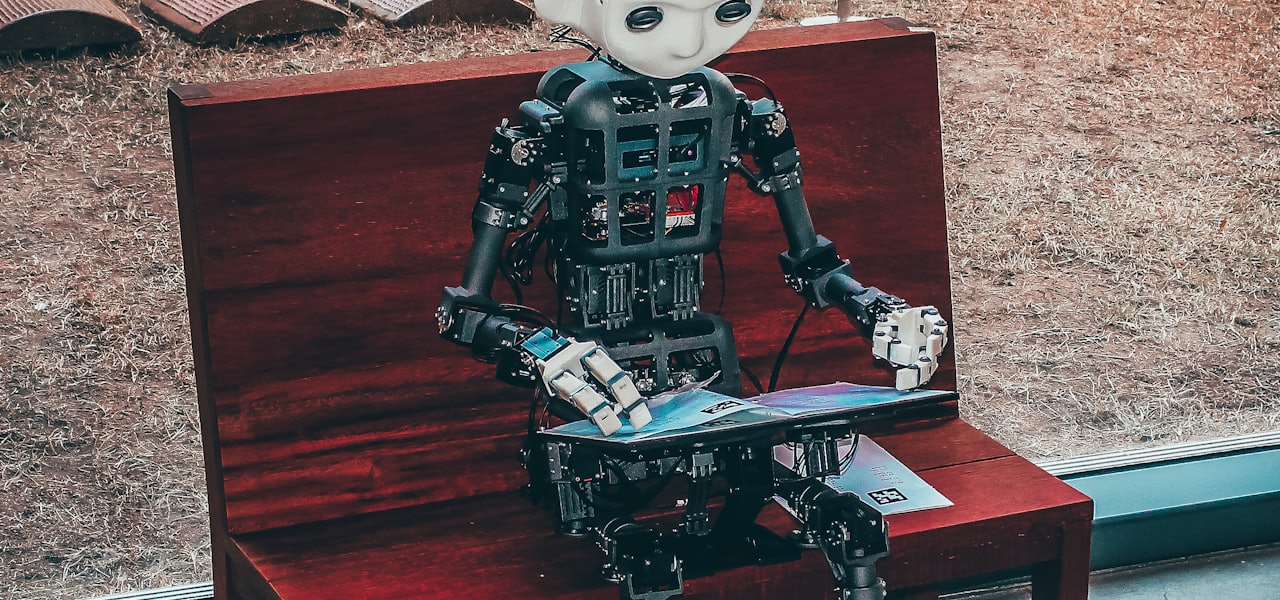
    The Frankenstein complex is a term coined by Isaac Asimov in his robot series, referring to the fear of mechanical men. == History == Some of Asimov's science fiction short stories and novels predict that this suspicion will become strongest and most widespread in respect of "mechanical men" that most-closely resemble human beings (see android), but it is also present on a lower level against robots that are plainly electromechanical automatons. The "Frankenstein complex" is similar in many respects to Masahiro Mori's uncanny valley hypothesis. The name, "Frankenstein complex", is derived from the name of Victor Frankenstein in the 1818 novel Frankenstein; or, The Modern Prometheus by Mary Shelley. In Shelley's story, Frankenstein created an intelligent, somewhat superhuman being, but he finds that his creation is horrifying to behold and abandons it. This ultimately leads to Victor's death at the conclusion of a vendetta between himself and his creation. In much of his fiction, Asimov depicts the general attitude of the public towards robots as negative, with ordinary people fearing that robots will either replace them or dominate them, although dominance would not be allowed under the specifications of the Three Laws of Robotics, the first of which is: "A robot may not harm a human being or, through inaction, allow a human being to come to harm." However, Asimov's fictitious earthly public is not fully persuaded by this, and remains largely suspicious and fearful of robots. I, Robot's short story "Little Lost Robot" is about this "fear of robots". In Asimov's robot novels, the Frankenstein complex is a major problem for roboticists and robot manufacturers. They do all they can to reassure the public that robots are harmless, even though this sometimes involves hiding the truth because they think that the public would misunderstand it. The fear by the public and the response of the manufacturers is an example of the theme of paternalism, the dread of paternalism, and the conflicts that arise from it in Asimov's fiction. The same theme occurs in many later works of fiction featuring robots, although it is rarely referred to as such.

    Read more →
  • PCPaint

    PCPaint

    PCPaint was one of the first IBM PC-based mouse-driven GUI paint programs, released in 1984. It followed after Microsoft Doodle, released in 1983 with the Microsoft Mouse version 1 drivers for DOS, and around the same time as Digital Research’s Draw program. It was developed and created by John Bridges and Doug Wolfgram. It was later developed into Pictor Paint. The hardware manufacturer Mouse Systems bundled PCPaint with millions of computer mice that they sold, making PCPaint one of the best-selling DOS-based paint programs of the mid 1980s. == History == In 1983, Doug Wolfgram bought a Microsoft Mouse and decided to write a drawing program for it. They named it “Mouse Draw”. The interface was primitive but the program functioned well. Wolfgram traveled to SoftCon in New Orleans where he demonstrated the program to Mouse Systems. Mouse Systems was developing an optical mouse and they wanted to bundle a painting program so they agreed to publish Mouse Draw. The original program was written entirely in assembly language with primitive graphics routines developed by Wolfgram. John Bridges worked for an educational software company, Classroom Consortia Media, Inc., developing and writing Apple and IBM graphics libraries for CCM's software. Bridges and Wolfgram were friends who had been connected through a bulletin board system developed and run by Wolfgram. The two collaborated cross country via the BBS, Wolfram in California and Bridges in New York. Mouse Systems wanted the paint program to capture the look and feel of MacPaint. John Bridges and Doug Wolfgram started reworking Mouse Draw into what became PCPaint. The program was completely re-written using Bridge's graphics library and the top-level elements were written in C rather than assembly language. Bridges developed the core graphics code for the first version of PCPaint while Wolfgram worked on the user interface and top-level code. Mouse Systems signed an exclusive agreement with Wolfgram's company, Microtex Industries, Inc., to bundle PCPaint with every mouse they sold. They began publishing PCPaint with their mice in 1984. Microsoft responded in 1985 by bundling a competing product, PC Paintbrush, with version 4 of its DOS drivers for the Microsoft Mouse, replacing its in-house Microsoft Doodle program which it published with version 1 of the DOS drivers in mid-1983. Microsoft’s mouse began to outsell Mouse Systems mouse. In November 1985 Microsoft bundled a cut-down version of PC Paintbrush with Windows 1.0 (called Microsoft Paint), later bundling an updated version of PC Paintbrush with Windows 3.0 (as Paintbrush), impacting PCPaint’s marketshare. In early 1987, Mouse Systems decided that PCPaint wasn't helping to sell mice any longer so they discontinued the bundle deal and returned rights to the code to MicroTex Industries, but retained rights to the name, PCPaint. Wolfgram then combined the paint program with a new animation system he was developing (called GRASP) and Paul Mace Software bought publishing rights to the animation system and PCPaint, which was to be renamed Pictor. Bridges again got involved and took over programming responsibilities for GRASP as well as PCPaint while Wolfgram focused on more of the business details. In creating the first version of PCPaint, Doug had a dual-floppy machine with a Computer Innovations compiler on one disk and source code on the other. John had the "luxury" of a 10MB hard disk in his XT. Data was exchanged daily via 1200, then 2400 baud modems. === Authorship and Ownership === John Bridges and Wolfgram continued to work on PCPaint and GRASP on behalf of Paul Mace Software until 1990. Also in that year, Doug Wolfgram sold his remaining rights to PCPaint (and its animation system, GRASP) to John Bridges. In 1994, GRASP development stopped and so did development of Pictor Paint. John Bridges terminated his GRASP publishing contract with Paul Mace Software, and went off to create GLPro (the next generation of GRASP) with GMEDIA. Along with GLPro, came GLPaint, the successor to PCPaint and Pictor Paint. == Versions == In June 1984, Mouse Systems shipped PCPaint 1.0, the first GUI based Paint program for the IBM PC family of computers. John Bridges and Doug Wolfgram, were the co-authors of PCPaint 1.0. PCPaint 1.0 saved its graphics in a modified BSaved image format with the extension of ".PIC". The release of PCPaint Version 1.5 followed in late 1984, with the additions of graphics image compression for the .PIC format and support for "larger-than-screen" images. PCjr support was also added in this version after overcoming severe memory shortage problems getting PCPaint to run on the 128k PCjr. October 1985 saw the release of PCPaint 2.0. EGA support and publishing features were added to this version. The .PIC format was further refined, offering support for the rapidly expanding graphics capabilities of the PC and efficient image compression. PCPaint 3.1 was released in 1989. Unlike previous versions, it was not bundled with mice but was sold as a stand-alone software product. PCPaint 3.1 offered improved text and image handling, provided 36 types of flood and fill, worked with VGA adapters in hi-res 16-color and 256-color modes, allowed the user to save and retrieve files in a variety of intercompatible formats (.PIC, .GIF, .PCX, .IMG), and printed selected portions of images on color or black-and-white dot matrix, ink jet, and laser printers such as PostScript and HP Laser Jet. PCPaint 3.1 is still in use today by some users of DOS emulation programs like DOSBox and available for free download. Pictor Paint was an improved version, written by John Bridges, and bundled with GRASP GRaphical System for Presentation also written by John Bridges. It was also called "The Painter's Easel". GLPaint, released in 1995, was the last in this series of paint programs written by John Bridges. By 1998 version 7.0 provided support for TrueColor images and the Pictor PIC format was expanded to handle these. == Pictor PIC Image Format == PCPaint 1.0 saved its graphics in a modified BSAVE image format (which was popular at the time) with the file type (extension) of ".PIC". By PCPaint 1.5 this format was extended further to accommodate image compression. With the release of version 2.0 the PICtor PIC image format was developed almost to its present state, with no similarity to the BSAVE format used by earlier versions. Pictor Paint saved its files in a compressed format with the file extension PIC, which was the same format used by PCPaint.

    Read more →
  • The Master Algorithm

    The Master Algorithm

    The Master Algorithm: How the Quest for the Ultimate Learning Machine Will Remake Our World is a book by Pedro Domingos released in 2015. Domingos wrote the book in order to generate interest from people outside the field. == Overview == The book outlines five approaches of machine learning: inductive reasoning, connectionism, evolutionary computation, Bayes' theorem and analogical modelling. The author explains these tribes to the reader by referring to more understandable processes of logic, connections made in the brain, natural selection, probability and similarity judgments. Throughout the book, it is suggested that each different tribe has the potential to contribute to a unifying "master algorithm". Towards the end of the book the author pictures a "master algorithm" in the near future, where machine learning algorithms asymptotically grow to a perfect understanding of how the world and people in it work. Although the algorithm doesn't yet exist, he briefly reviews his own invention of the Markov logic network. == In the media == In 2016 Bill Gates recommended the book, alongside Nick Bostrom's Superintelligence, as one of two books everyone should read to understand AI. In 2018 the book was noted to be on Chinese Communist Party general secretary Xi Jinping's bookshelf. === Reception === A computer science educator stated in Times Higher Education that the examples are clear and accessible. In contrast, The Economist agreed Domingos "does a good job" but complained that he "constantly invents metaphors that grate or confuse". Kirkus Reviews praised the book, stating that "Readers unfamiliar with logic and computer theory will have a difficult time, but those who persist will discover fascinating insights." A New Scientist review called it "compelling but rather unquestioning".

    Read more →
  • Enterprise resource planning

    Enterprise resource planning

    Enterprise resource planning (ERP) is the integrated management of main business processes, often in real time and mediated by software and technology. ERP is usually referred to as a category of business management software—typically a suite of integrated applications—that an organization can use to collect, store, manage and interpret data from many business activities. The finance module in particular is essential to a suite of applications meeting the definition of an ERP system. The finance module provides the system of record for the organisation; recording the commercial impact of the business operations in the General Ledger. ERP systems can be local-based or cloud-based. Cloud-based applications have grown rapidly since the early 2010s due to the increased efficiencies arising from information being readily available from any location with Internet access. However, ERP differs from integrated business management systems by including planning all resources that are required in the future to meet business objectives. This includes plans for getting suitable staff and manufacturing capabilities for future needs. ERP provides an integrated and continuously updated view of core business processes, typically using a shared database managed by a database management system. ERP systems track business resources—cash, raw materials, production capacity—and the status of business commitments: orders, purchase orders, and payroll. The applications that make up the system share data across various departments (manufacturing, purchasing, sales, accounting, etc.) that provide the data. ERP facilitates information flow between all business functions and manages connections to outside stakeholders. Estimates of the size of the global ERP market range between USD $78 and $81 billion in 2026 . Though early ERP systems focused on large enterprises, smaller enterprises increasingly use ERP systems. The ERP system integrates varied organizational systems and facilitates error-free transactions and production, thereby enhancing the organization's efficiency. However, developing an ERP system differs from traditional system development. ERP systems run on a variety of computer hardware and network configurations, typically using a database as an information repository. == Origin == Business and technology research and advisory firm Gartner is credited for first using the acronym ERP in the 1990s. The term captured a functional extension of two manufacturing-based concepts, material requirements planning (MRP) and manufacturing resource planning (MRP II). Without replacing these terms, ERP came to represent a larger whole that reflected the evolution of application integration beyond manufacturing. Not all ERP packages are developed from a manufacturing core; ERP vendors variously began assembling their packages with finance-and-accounting, maintenance, and human-resource components. By the mid-1990s ERP systems addressed all core enterprise functions. Governments and non–profit organizations also began to use ERP systems. An "ERP system selection methodology" is a formal process for selecting an enterprise resource planning (ERP) system. Existing methodologies include: Kuiper's funnel method, Dobrin's three-dimensional (3D) web-based decision support tool, and the Clarkston Potomac methodology. == Expansion == ERP systems experienced rapid growth in the 1990s. Because of the year 2000 problem many companies took the opportunity to replace their old systems with ERP. ERP systems initially focused on automating back office functions that did not directly affect customers and the public. Front office functions, such as customer relationship management (CRM), dealt directly with customers, or e-business systems such as e-commerce and e-government—or supplier relationship management (SRM) became integrated later, when the internet simplified communicating with external parties. "ERP II" was coined in 2000 in an article by Gartner Publications entitled ERP Is Dead—Long Live ERP II. It describes web–based software that provides real–time access to ERP systems to employees and partners (such as suppliers and customers). The ERP II role expands traditional ERP resource optimization and transaction processing. Rather than just manage buying, selling, etc.—ERP II leverages information in the resources under its management to help the enterprise collaborate with other enterprises. ERP II is more flexible than the first generation ERP. Rather than confine ERP system capabilities within the organization, it goes beyond the corporate walls to interact with other systems. Enterprise application suite is an alternate name for such systems. ERP II systems are typically used to enable collaborative initiatives such as supply chain management (SCM), customer relationship management (CRM) and business intelligence (BI) among business partner organizations through the use of various electronic business technologies. The large proportion of companies are pursuing a strong managerial targets in ERP system instead of acquire an ERP company. Developers now make more effort to integrate mobile devices with the ERP system. ERP vendors are extending ERP to these devices, along with other business applications, so that businesses don't have to rely on third-party applications. As an example, the e-commerce platform Shopify was able to make ERP tools from Microsoft and Oracle available on its app in October 2021. Technical stakes of modern ERP concern integration—hardware, applications, networking, supply chains. ERP now covers more functions and roles—including decision making, stakeholders' relationships, standardization, transparency, globalization, etc. == Functional areas == An ERP system covers the following common functional areas. In many ERP systems, these are called and grouped together as ERP modules: Financial accounting: general ledger, fixed assets, payables including vouchering, matching and payment, receivables and collections, cash management, financial consolidation Management accounting: budgeting, costing, cost management, activity based costing, billing, invoicing (optional) Human resources: recruiting, training, rostering, payroll, benefits, retirement and pension plans, diversity management, retirement, separation Manufacturing: engineering, bill of materials, work orders, scheduling, capacity, workflow management, quality control, manufacturing process, manufacturing projects, manufacturing flow, product life cycle management Order processing: order to cash, order entry, credit checking, pricing, available to promise, inventory, shipping, sales analysis and reporting, sales commissioning Supply chain management: supply chain planning, supplier scheduling, product configurator, order to cash, purchasing, inventory, claim processing, warehousing (receiving, putaway, picking and packing) Project management: project planning, resource planning, project costing, work breakdown structure, billing, time and expense, performance units, activity management Customer relationship management (CRM): sales and marketing, commissions, service, customer contact, call center support – CRM systems are not always considered part of ERP systems but rather business support systems (BSS) Supplier relationship management (SRM): suppliers, orders, payments. Data services: various "self-service" interfaces for customers, suppliers or employees Management of school and educational institutes. Contract management: creating, monitoring, and managing contracts, reducing administrative burdens and minimising legal risks. These modules often feature contract templates, electronic signature capabilities, automated alerts for contract milestones, and advanced search functionality. === GRP – ERP use in government === Government resource planning (GRP) is the equivalent of an ERP for the public sector and an integrated office automation system for government bodies. The software structure, modularization, core algorithms and main interfaces do not differ from other ERPs, and ERP software suppliers manage to adapt their systems to government agencies. Both system implementations, in private and public organizations, are adopted to improve productivity and overall business performance in organizations, but comparisons (private vs. public) of implementations shows that the main factors influencing ERP implementation success in the public sector are cultural. == Best practices == Most ERP systems incorporate best practices. This means the software reflects the vendor's interpretation of the most effective way to perform each business process. Systems vary in how conveniently the customer can modify these practices. Use of best practices eases compliance with requirements such as International Financial Reporting Standards, Sarbanes–Oxley, or Basel II. They can also help comply with de facto industry standards, such as electronic funds transfer. This is because the procedure can be readily

    Read more →
  • DAVI

    DAVI

    The Dutch Automated Vehicle Initiative (DAVI) is a research and demonstration initiative developing automated vehicles for use on public roads. The project is unique in that, besides simply making driverless cars, it also focuses on having automated vehicles share information among each other. The aim is to have the cars help to avoid traffic congestion by reducing the safety distance between the cars (from 2 seconds to 0.5 seconds) and avoiding sudden traffic slow-downs due to maneuvers undertaken by drivers.

    Read more →
  • Voice search

    Voice search

    Voice search, also called voice-enabled search, allows the user to use a voice to search the Internet, a website, or an app. In a broader definition, voice search includes open-domain keyword query on any information on the Internet, for example in Google Voice Search, Cortana, Siri and Amazon Echo. Voice search is often interactive, involving several rounds of interaction that allows a system to ask for clarification. Voice search is a type of dialog system. Voice search is not a replacement for typed search. Rather the search terms, experience and use cases can differ heavily depending on the input type. == Supported language == Language is the most essential factor for a system to understand, and provide the most accurate results of what the user searches. This covers across languages, dialects, and accents, as users want a voice assistant that both understands them and speaks to them understandably. While spoken and written languages differ, voice search should support natural spoken language instead of only transforming voice into text and doing a regular text search with the help speech recognition. For example, in typed search an eCommerce user can easily copy and paste an alphanumeric product code to search field, but when speaking the search terms can be very different, such as "show me the new Bluetooth headphones by Samsung". == How it works == The difference between text and voice search is not only the input type. The mechanism must include an automatic speech recognition (ASR) for input, but it can also include natural language understanding for natural spoken search queries such as "What's the population for the United States" It can include text-to-speech (TTS) or a regular display for output modalities. Users might sometimes be required to activate the search by using a wake word. Then, the search system will detect the language spoken by the user. It will then detect the keywords and context of the sentence. Lastly, the device will return results depending on its output. A device with a screen might display the results, while a device without a screen will speak them back to the searcher.

    Read more →
  • N-jet

    N-jet

    An N-jet is the set of (partial) derivatives of a function f ( x ) {\displaystyle f(x)} up to order N. Specifically, in the area of computer vision, the N-jet is usually computed from a scale space representation L {\displaystyle L} of the input image f ( x , y ) {\displaystyle f(x,y)} , and the partial derivatives of L {\displaystyle L} are used as a basis for expressing various types of visual modules. For example, algorithms for tasks such as feature detection, feature classification, stereo matching, tracking and object recognition can be expressed in terms of N-jets computed at one or several scales in scale space.

    Read more →
  • Robinson compass mask

    Robinson compass mask

    In image processing, a Robinson compass mask is a type of compass mask used for edge detection. It has eight major compass orientations, each will extract the edges in respect to its direction. A combined use of compass masks of different directions could detect the edges from different angles. == Technical explanation == The Robinson compass mask is defined by taking a single mask and rotating it to form eight orientations: North: [ − 1 0 1 − 2 0 2 − 1 0 1 ] {\displaystyle {\text{North:}}{\begin{bmatrix}-1&0&1\\-2&0&2\\-1&0&1\end{bmatrix}}} North West: [ 0 1 2 − 1 0 1 − 2 − 1 0 ] {\displaystyle {\text{North West:}}{\begin{bmatrix}0&1&2\\-1&0&1\\-2&-1&0\end{bmatrix}}} West: [ 1 2 1 0 0 0 − 1 − 2 − 1 ] {\displaystyle {\text{West:}}{\begin{bmatrix}1&2&1\\0&0&0\\-1&-2&-1\end{bmatrix}}} South West: [ 2 1 0 1 0 − 1 0 − 1 − 2 ] {\displaystyle {\text{South West:}}{\begin{bmatrix}2&1&0\\1&0&-1\\0&-1&-2\end{bmatrix}}} South: [ 1 0 − 1 2 0 − 2 1 0 − 1 ] {\displaystyle {\text{South:}}{\begin{bmatrix}1&0&-1\\2&0&-2\\1&0&-1\end{bmatrix}}} South East: [ 0 − 1 − 2 1 0 − 1 2 1 0 ] {\displaystyle {\text{South East:}}{\begin{bmatrix}0&-1&-2\\1&0&-1\\2&1&0\end{bmatrix}}} East: [ − 1 − 2 − 1 0 0 0 1 2 1 ] {\displaystyle {\text{East:}}{\begin{bmatrix}-1&-2&-1\\0&0&0\\1&2&1\end{bmatrix}}} North East: [ − 2 − 1 0 − 1 0 1 0 1 2 ] {\displaystyle {\text{North East:}}{\begin{bmatrix}-2&-1&0\\-1&0&1\\0&1&2\end{bmatrix}}} The direction axis is the line of zeros in the matrix. Robinson compass mask is similar to kirsch compass masks, but is simpler to implement. Since the matrix coefficients only contains 0, 1, 2, and are symmetrical, only the results of four masks need to be calculated, the other four results are the negation of the first four results. An edge, or contour is an tiny area with neighboring distinct pixel values. The convolution of each mask with the image would create a high value output where there is a rapid change of pixel value, thus an edge point is found. All the detected edge points would line up as edges. == Example == An example of Robinson compass masks applied to the original image. Obviously, the edges in the direction of the mask is enhanced.

    Read more →
  • Clip Studio Paint

    Clip Studio Paint

    Clip Studio Paint (previously marketed as Manga Studio in North America), informally known in Japan as Kurisuta (クリスタ), is a family of software applications developed by Japanese graphics software company Celsys. It is used for the digital creation of comics, general illustration, and 2D animation. The software is available in versions for macOS, Windows, iOS, iPadOS, Android, and ChromeOS. The program is widely used by amateur and professional comics creators, and animation studios. The application is sold in editions with varying feature sets. The full-featured edition is a page-based, layered drawing program, with support for bitmap and vector art, text, imported 3D models, and frame-by-frame animation. It is designed for use with a stylus and a graphics tablet or tablet computer. It has drawing tools which emulate natural media such as pencils, ink pens, and brushes, as well as patterns and decorations. It is distinguished from similar programs by features designed for creating comics: tools for creating panel layouts, perspective rulers, sketching, inking, applying tones and textures, coloring, and creating word balloons and captions. == History == The application has it origins in a program for macOS and Windows, released in Japan in 2001 as "Comic Studio". It was sold as "Manga Studio" in the Western market by E Frontier America until 2007, then by Smith Micro Software. Early versions were designed for creating black and white art with only spot color (a typical format for Japanese manga), with version 4 adding support for full-color art. Celsys developed Clip Studio Paint as a replacement for this product, based on the company's Illust Studio application, and it was released on May 31, 2012. It was initially distributed in Western markets as "Manga Studio 5", but in 2016, the branding was unified worldwide as "Clip Studio Paint". At this time, version 1.5.4 introduced a new file format (extension .clip) and frame-by-frame animation. In late 2017, Celsys took over direct support for the software worldwide, and ceased its relationship with Smith Micro. In July 2018, Celsys began a partnership with Graphixly for distribution in North America, South America, and Europe. Clip Studio Paint for the Apple iPad was introduced in November 2017, and for the iPhone in December 2019. Clip Studio Paint for Samsung Galaxy tablets and smartphones was released in August 2020 on the Galaxy Store, with versions for other Android devices and Chromebooks released in December. The Windows and macOS versions of the software have been sold and distributed either from the developer's web site or on DVD, and purchased either with a perpetual license or an ongoing subscription. The versions for iPhone, iPad, and Android-based devices are distributed through the corresponding app stores free of charge, but require a subscription – which includes cloud storage – for unrestricted use. Without a subscription, the tablet versions can be used only for a specified number of months, and the phone versions can be used only for 30 hours per month. From 2013 to 2023, regular updates for version 1 were distributed free of additional charge to both perpetual and subscription users. Since the release of version 2 in 2023, feature updates are included only in subscription plans and are available to perpetual licenses at an additional cost. Perpetual licenses can be upgraded permanently or with an annual "update pass". The "update pass" provides early access to features to be included in subsequent perpetual licenses for 12 months, after which the software reverts to the original license if not renewed. In March 2024, version 3 was released, and version 4 introduced additional features in March 2025. == Editions == Clip Studio Paint is available in three editions, with differing feature sets and prices: Debut (bundle-only grade), Pro (adding support for vector-based drawing, custom textures, and comics-focused features), and EX (adding support for multi-page documents, book exporting, and 2D animation). Companion programs include Clip Studio (for managing and sharing digital assets distributed through the Clip Studio web site, managing licenses, and getting updates and support) and Clip Studio Modeler (for setting up 3D materials to use in Clip Studio Paint).

    Read more →